Performing Stories

Where performing stories “starts”

How do we define what a story is? What characteristics does it have? Where does a Western understanding of performing stories come from?

This page covers some of the material that we will be looking at in our second class. If you missed class or you want to learn more or review, you can work through the following material. If you would rather move on, scroll to the bottom of the page to continue the module.

Telling Stories the Ancient Greek Way


Storytelling and acting are not necessarily the same, but there are similarities. The plays we have from the classical Greek theatre are another source of the traditional stories that we have. Here myths become literary – they become the interpretation of one particular writer.
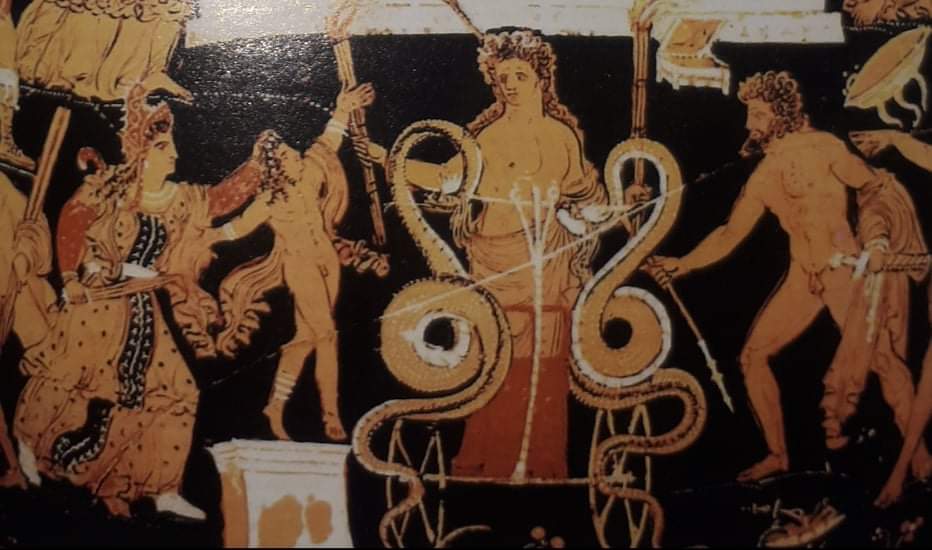
Depiction on pottery of a woman, surrounded by two snakes, to her left is a naked man, to her right a small naked male child on a plinth and a woman with a knife holding him by the head
Medea in Corinth, Apulian red figured volute krater, attributed to The Underworld Painter, circa 330 – 310 BC Late Classical/Early Hellenistic; Deiadameian, CC BY-SA 4.0, via Wikimedia Commons

In the following videos, you will learn about shifts in how stories get performed with the birth of the Greek theatre.

In the second video, you will meet Aristotle (or re-meet him; you may know him from his philosophical works on ethics and rhetoric – logos, ethos, and pathos – that’s him!). Aristotle defines much of what we know about stories: what makes them work, what elements are needed for stories, and what the purpose of a story (at least tragedy) is. We don’t know what he had to say about comedy, but there were probably similarities.


Videos #1 and #2 are a part of the Crash Course Theatre History project.

Optional: What about non-Western performances of stories?

There’s a lot to say on this subject, but you might find the use of myth in the Sanskrit drama of ancient India interesting to explore.

23 responses to “Performing Stories”

  1. Amy Merino Avatar
    Amy Merino

    I do agree with Aristotle because we follow the same structure for most stories from books to movies. We see a slight change in series where we are left at a cliffhanger but once it is all said and done we always end up with some sort of resolution. As Aristotle said we have a plot, beginning, middle and end, some sort of climax occurring and ending with a resolution. A moment when the adience releases emotions. Depending on the story being told we as the audience might feel tense, or scared, or joy, or sad.

  2. Aleksandra Avatar
    Aleksandra

    Aristotle’s emphasis on plot is the most crucial element that’s logical without a compelling structure, even great characters and themes can fall flat. I also appreciate his focus on catharsis, which highlights the emotional journey of the audience. Modern storytelling sometimes challenges his rules. For example, character-driven stories or experimental narratives can still be captivating without a traditional plot. While I agree with much of Aristotle’s framework, storytelling today is more diverse and often bends those classical rules.

  3. D'Ella Brown Avatar
    D’Ella Brown

    Yes I do agree with Aristotle on what makes a good story. He set the standard for what makes a story that is taught in schools so he must be correct. These elements are shown in movies as well, especially emotion provoking moments.

  4. Synphanie Mojica Avatar
    Synphanie Mojica

    I do agree on what makes a good story according to Aristotle, especially the part about the definition of tragedy because in order for a tragedy to really connect, the story must resonate with us to feel the pain and suffering that the character is going through. I also think that Aristotle’s view is more relevant for live storytelling, plays, or theatre, where action is more important than narrative, because the audience would have a fuller experience of tragedy this way.

  5. Danielle Avatar
    Danielle

    I agree with Aristotle that a good story needs a clear beginning, middle, and end to make sense and keep the audience interested. He also believed that strong characters make a story more powerful, and I agree that when we connect with a character we care more about what happens. His idea of catharsis we feel from a story, is also important because it helps us process our own emotions. Lastly, I agree that every part of a story should have a purpose.

  6. Denise Warren Avatar
    Denise Warren

    According to Aristotle’s theory, an excellent plot and tragic action is key to creating a great story. The Greek philosopher is correct in saying this, as everyone pretty much knows that great plots produce the best stories. Aristotle understood very early that people gravitate towards action and spectacle, which is very evident in movies/shows today. he also placed emphasis on having commanding characters and pleasing songs in acting. Although there was an era when people appreciated films, there isn’t a show today without a soundtrack/theme song. Aristotle’s emphasis on tragedy is evident that audiences can connect with the events in shows with their own experiences when things go awry in these shows.

  7. Salma Avatar
    Salma

    Aristotle thought the plot was the most important part of a story. It keeps people engaged. I agree because these things still make stories entertaining.

  8. Kajol Victoria Singh Avatar
    Kajol Victoria Singh

    Aristotle places a lot of focus on plot and the details of the tragedy and main character itself according to the video – this can fall true in many shows and movies so it can be agreeable.

  9. Sophia Awad Avatar
    Sophia Awad

    I believe I agree with Aristotle’s belief on what makes a good story, as he feels that it involves a good combination of intellect and emotional impact, which I strongly agree with. Aristotle lists 5 components of tradition that he feels are necessary as they create a balanced story. These five aspects are plot, character, diction, thought, song, and spectacle. Song and spectacle I like to think of them as embelishments to the foundation of the story, as they work as the sprinkle on top. They add a lingering impact on the audience by illuminating the emotional tribute of the experience. The plot and character are the most important aspects to include, as without them you do not have a story at all. Both diction and thought are crucial to the presentation of the story, as diction is obviously the way it is said and thought is the way it carries out to portray a theme. Thus, all the components work hand in hand to produce a fantastic framework for a story, but it is up to the writer to create the art that makes the whole story worth a read.

  10. Jada Williams Avatar
    Jada Williams

    Although Aristotle mentions character, diction, thought, song and spectacle as key aspects of stories I do agree with plot being the most important. Plot is what creates the character and gives the author ideas of what to make them say and how to behave. When you have the plot songs also come based on the mood and what scene is portrayed. Plot is what creates the story. It is the beginning, middle and end along with how the message is portrayed.

  11. Calista Spezio Avatar
    Calista Spezio

    I do agree with Aristotle’s view on what makes a good story. He emphasized the importance of plot and characters, saying that a strong story must have a clear beginning, middle, and end, I also agree because Aristotle said a story needs a great structure, relatable characters, and it has to have an emotional impact on the audience, I can’t think of a better story.

  12. Aliviya Iskhakova Avatar
    Aliviya Iskhakova

    I agree with Aristotle’s view on a good story because I feel like he puts a great emphasis on compelling viewers. His views on what makes a tragedy is plot elements we still see in theater, TV shows, books, and movies in the modern age. For instance, a lot of stories will involve a good character becoming bad and a bad character turning into a good one. Similarly, we see story elements like reversal, recognition, and scenes of suffering in all forms of media to paint a tragedy. Aristotle’s tips on writing a compelling tragedy are timeless.

  13. Shania Smith Avatar
    Shania Smith

    I completely agree with Aristotle. I think people are attracted to things that surprise them or things they may be able to relate to. There has to be some kind of tragedy towards the “good character” which leaves people hanging off their seats. The plot is very important because there has to be a story to invoke emotion. The tragedy has to be enjoyable but not too positive. There also needs to be a beginning middle and end. This is still used in modern plays and storytelling.

  14. Jairy Arana Avatar
    Jairy Arana

    I agree with Aristotle’s ideas about what makes a good story, particularly his emphasis on structure, emotional depth, and the terms “hamartia”, “peripeteia”, and “anagnorisis”. These elements remain relevant in modern storytelling, particularly in tragedies where emotional engagement and catharsis are important. However, modern narratives occasionally deviate from his formula, experimenting with non-linear structures or characters who do not fit traditional stereotypes. While Aristotle’s principles are still relevant, contemporary stories have grown beyond his exact guidelines.

  15. Winnie Chow Avatar
    Winnie Chow

    I do agree with Aristotle on what makes a good story. The structure allows for a balanced and satisfied reading experience. Keeping the readers engaged with a plot that they can follow is one of the greatest things a story can have. If they didn’t, then no one would be reading it since there’s no reason why they should be following along or getting interested in the characters no matter how interesting they may be.

  16. Anismery Blanco Avatar
    Anismery Blanco

    I agree with Aristotle’s ideas that in a story if there is tragedy there should consist of 7 things; plot, character, diction, thought, song, spectacle, with all of these you should have a good story or play. 3 things are needed for a good tragedy scene would be reversal, recognition, scene of suffering. Normally when bad things happen to a good character it has a more dramatic affect than when something bad happens to a not so good character.
    As well as the suspense playing a big part of the story line.

  17. Crystal Ebanks Avatar
    Crystal Ebanks

    I agree with Aristotle’s ideas of what a good story should contain. A good story, especially one with a tragedy in it, should be well-structured for the readers/audience to either resonate or to feel the depiction of emotions in said story.

  18. Layla Ettu Avatar
    Layla Ettu

    I do agree with Aristotle about what makes a good story. Every book, movie or play you’ve seen always has a well thought out beginning, middle and end with the events flowing in a cause and effect manner. I also agree with Aristotle when he said that the plot is the most important part of most stories. No matter what book or movie you’re watching, the plot is what’s going to take us on this adrenaline rush journey.

  19. cindy ambrosio Avatar
    cindy ambrosio

    I agree with Aristotle because I think that plot is important for a good story. Without a good plot, the story may seem flat and boring. I also believe that character development is important. He explains that a character should be mostly good, then become bad through the tragedies in the story. The reader should be able to see the effect that the tragedy had on the character and how the character changed. The tragedy itself should also be surprising or some sort of accident, and not anticipated.

  20. Zoe Davis Avatar
    Zoe Davis

    I agree with what everyone else has said regarding Aristotle’s view of story structure. If a story doesn’t have a plot, characters, etc, then it won’t be good! These things add complexity to every story and give readers the chance to connect to and learn from them.

  21. Jacklyn Serrano Avatar
    Jacklyn Serrano

    Aristotle says the plot is the most important part of a good tragedy. The plot should have a scene of suffering, where something bad happens to the character. All of this should build up to make a tragedy anxiety-inducing and memorable!

  22. Malissa Solon Avatar
    Malissa Solon

    I agree with Artistotle, the plot of a story is very important when telling a story and if a story were to not have a plot it won’t be a good story.He also mentioned the way a story is told with characters aswell and the events helps make a story good which I agree with because that’s what keeps the reader wanting to read more.

  23. Chadeary Avatar
    Chadeary

    Yeah, I mostly agree with Aristotle about what makes a good story. He talked about how a strong plot is really the heart of any good story you need a clear beginning, middle, and end, and everything should connect logically. I think that still applies today because even with all the special effects and crazy characters we see in movies and shows now, if the story itself doesn’t make sense or doesn’t move you emotionally, it just doesn’t hit the same. I also like how Aristotle pointed out the idea of catharsis that a good story should make you feel something, like tension and then release. That emotional rollercoaster is still what keeps people hooked on stories today.

Leave a Reply

Your email address will not be published. Required fields are marked *
